
Your Sales Page Shouldn’t Need Luck, Vibes, Or Endless Rewrites
If your sales page or VSL script isn’t converting, the worst part isn’t the lost revenue. It’s the uncertainty.
You can’t tell whether the problem is the headline, the offer, the proof, the structure, the objections, the CTA, or something you can’t even name.
So you do what almost everyone does: you start changing words.
That “rewrite until it works” loop is expensive. It burns time, confidence, ad spend, and momentum.
And it often makes pages worse, because random edits create random outcomes. You can’t build stable results on unstable decision-making.
Sales Page Fixer Pro AI Suite exists to end that loop.
Not by “making the copy sound nicer,” but by forcing a professional sequence: diagnose first, plan second, execute last. No overlap. No chaos. No wandering.
This is for anyone who wants to improve a sales page or a VSL script without playing whack-a-mole with sections that keep breaking every time you touch them.
If you want clarity, a real process, and a final page you can deploy or hand to clients with confidence, keep reading.
Most Sales Pages Fail Because The Fix Happens In The Wrong Order
A sales page can look “good” and still fail because the first problem isn’t the writing. It’s the order of operations.
When you rewrite before you diagnose, you can end up polishing a weak angle, strengthening a claim buyers don’t believe, or making a CTA louder when the real issue is trust.
That’s why two smart people can look at the same page and recommend totally different changes. They’re reacting to symptoms, not identifying the root cause.
The page might have a clarity problem, a positioning problem, a proof problem, an objection problem, or an offer framing problem.
Those are not solved by “better copy.” They’re solved by the correct sequence: identify the leak, prioritize it, then rewrite based on a plan.
Sales Page Fixer Pro AI Suite was built to enforce that sequence. It’s not a single tool that tries to be clever.
It’s a three-part system where each GPT does one job, hands off to the next, and prevents the most common failure: mixing strategy and execution.
If you’ve been stuck in rewriting cycles, you’re not alone. The problem is the workflow, not your effort. The fix is a system that stops you from guessing.
Meet The System Built For Conversion Logic, Not Random Copy Changes
Sales Page Fixer Pro AI Suite is a structured way to repair sales pages and VSL scripts using a clean, repeatable workflow.
It’s designed for people who want consistent improvement, not one-off “maybe this helps” edits.
Instead of starting with rewriting, it starts with diagnosis. Instead of “tips,” it gives you ranked issues by impact.
Instead of rewriting from intuition, it generates a strategy that explains what must change and why. Then, and only then, it executes the rewrite according to the plan.
That matters because sales pages are systems. A page is not a pile of paragraphs. It’s a conversion path.
Buyers need clarity, a believable claim, a reason to trust you, proof that reduces doubt, objections handled before they become deal-breakers, and a clear next step that feels safe.
When any one of those pieces is missing, conversions drop. When multiple pieces are out of order, conversions collapse.
Sales Page Fixer Pro AI Suite exists to put the pieces in the right order and keep them there.
If you sell your own offer, this helps you stop bleeding conversions. If you serve clients, this gives you a defensible process that looks and feels professional, because it is.
Here’s The Verbatim Workflow Explanation You Wanted Included
Introducing…
See How This GPT Suite Works
Sales Page Fixer Pro is a 3-GPT system designed to fix sales pages in the correct order instead of guessing with copy.
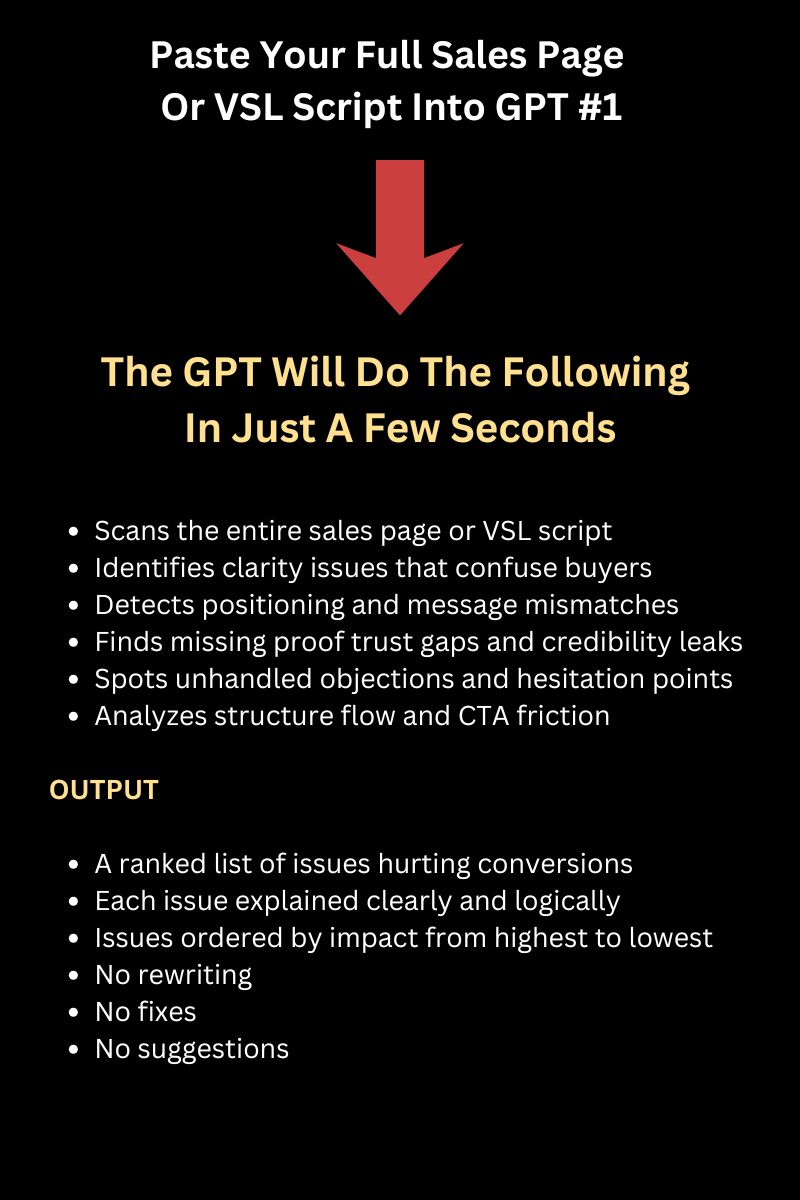
GPT #1 diagnoses what is broken
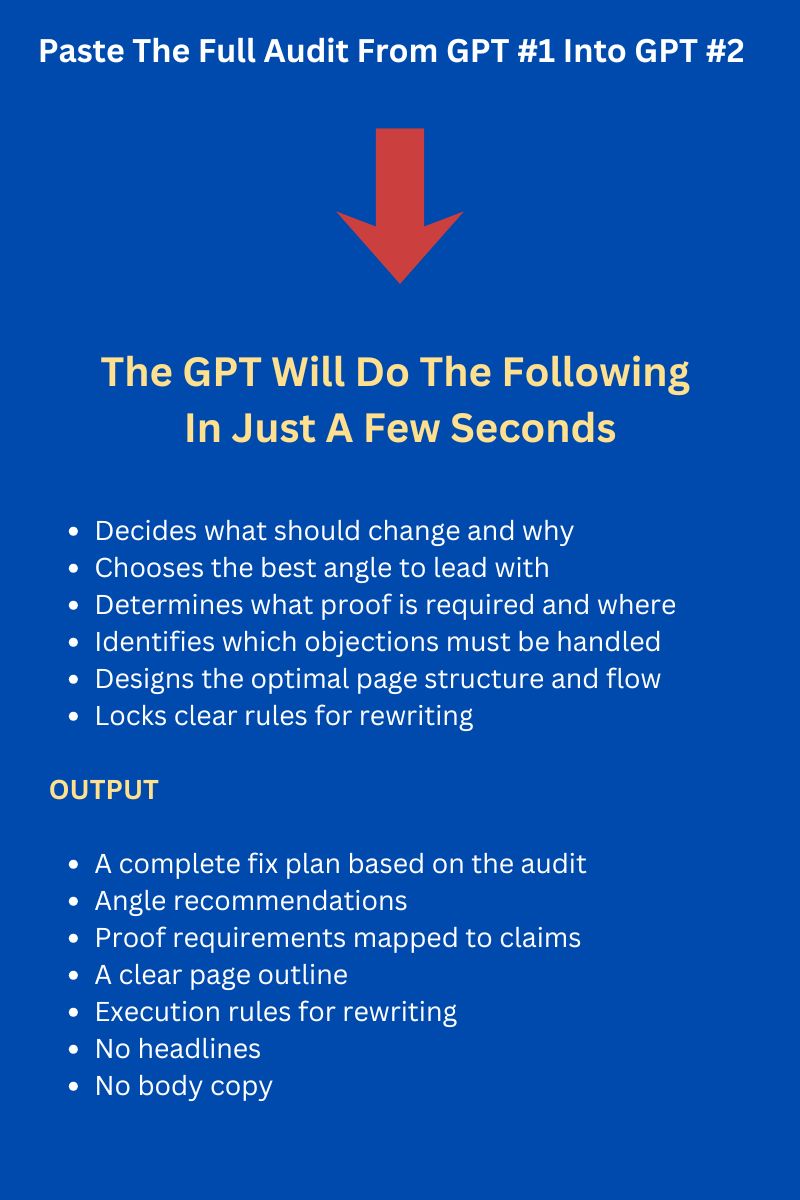
GPT #2 decides what must change and why
GPT #3 rewrites the page based on that plan
Each GPT has one job. Nothing overlaps.
You end with a fully rewritten sales page you can deploy, use, sell, or hand to clients immediately.
Let’s go over each GPT of this suite:
GPT #1 — Sales Page Auditor
This GPT exists for one reason: to find what is actually stopping the sale.
Step 1 — Load the sales page
Paste the full sales page copy or VSL script
No summaries. No explanations. The actual page only.
Step 2 — Lock the audit scope
Choose if the focus is:
- Cold traffic
- Warm traffic
- High ticket
- Low ticket
- VSL or written page
Step 3 — Diagnose conversion leaks
It analyzes clarity, positioning, offer structure, proof, objections, flow, and CTA friction
It looks for where buyers hesitate, doubt, or drop off
Step 4 — Rank issues by impact
Every issue is ranked by how much it likely affects conversions
High impact issues come first
Low impact polish comes last
Step 5 — Output the audit
You get a ranked breakdown of what is broken and why
- No fixes yet
- No rewriting yet
- No plan yet
This output becomes the input for GPT #2
GPT #2 — Fix Strategist
This GPT turns the audit into a clear plan before any copy is touched.
Step 1 — Load the audit
Paste the full output from GPT #1
Nothing else is required
Step 2 — Define the objective
It identifies the primary conversion goal
What must change first to move buyers forward
Step 3 — Build the fix plan
It decides
- What should change
- Why it matters
- What angle should lead
- What proof is required
- What objections must be handled
Step 4 — Design the structure
It outlines how the page should flow
- What moves up
- What moves down
- What gets emphasized
- What gets removed
Step 5 — Lock execution rules
It creates clear rules for rewriting
- What must stay
- What must not be added
- What tone and positioning to maintain
This output becomes the input for GPT #3
GPT #3 — Copy Executor
This GPT rewrites the page using the approved strategy only.
Step 1 — Load the strategy
Paste the full output from GPT #2
Optional: add brand voice or compliance rules
Step 2 — Rewrite the page
It rewrites
- Headlines
- Sections
- Transitions
- CTAs
- Proof placement
No re-auditing
No strategy changes
No shortcuts
Step 3 — Preserve persuasion depth
Copy is not shortened unless the strategy explicitly calls for it
Claims are supported with proof or placeholders
Nothing is fabricated
Step 4 — Deliver final assets
You receive a fully rewritten sales page
- Structured
- Clean
- Ready to deploy
The End Result
You are not guessing
You are not tweaking blindly
You are not rewriting for vibes
You get a sales page that has been
- Diagnosed
- Planned
- Executed
…In the correct order
Ready to deploy, use, sell, or hand to clients immediately

Why Three Separate GPTs Beat One “All-In-One” Rewrite Tool
When one tool tries to diagnose, strategize, and rewrite all at once, it often muddies the output.
You get a mix of opinions, edits, and reasoning with no clear chain of cause and effect.
That makes it hard to trust what changed, why it changed, and whether the change was the right one.
Splitting the work into three GPTs fixes that.
It creates a clean handoff: the auditor produces a ranked list of issues, the strategist turns that into a prioritized plan, and the executor rewrites according to the plan.
That separation protects you from the most common failure: rewriting based on assumptions.
It also makes the process easy to repeat. If you’re fixing multiple pages, you can run the same workflow every time and compare outputs.
If you’re serving clients, you can show them a professional sequence with artifacts at each step: audit, plan, final copy.
Most importantly, it keeps the rewrite aligned. The executor doesn’t wander into new strategy decisions. The strategist doesn’t invent proof.
The auditor doesn’t start “fixing” before diagnosis is complete. Each one stays in its lane, which is exactly what high-performing conversion teams do.
What You Can Improve When You Stop Guessing And Start Diagnosing
When you diagnose properly, you stop wasting time on low-impact polish. You go straight to the highest-leverage problems first.
That usually means fixing clarity, positioning, offer comprehension, and proof gaps before you ever worry about clever wording.
With the Sales Page Fixer Pro workflow, you get direction like: “This is the biggest leak and here’s where it happens.” That changes everything.
It turns rewriting from a creative exercise into an engineering process.
Here are examples of what often improves when pages are fixed in the correct order (results vary, and nothing is guaranteed): clearer above-the-fold messaging, cleaner offer presentation, stronger alignment between traffic temperature and promise, proof placed next to the claims that need it, objections handled before the final CTA, and fewer confusing sections that fight each other.
This isn’t about making the page longer or shorter. It’s about making the page make sense to the buyer, in the order the buyer needs to understand it.
When people say a page “feels persuasive,” they usually mean the path is clear, credible, and low-friction.
That’s what this suite helps you build.
Use It On Written Sales Pages, VSL Scripts, Or Client Projects
The suite is built to handle both written pages and VSL scripts because the underlying conversion problems are often the same: unclear promise, misaligned angle, weak proof, missing objection handling, and structural confusion.
If you’re running ads to a page, the “cold traffic” scope matters. If you’re sending warm leads, the “warm traffic” scope matters.
If you sell high ticket, the trust and objection stack matters. If you sell low ticket, clarity and simplicity matter.
The Auditor forces you to lock that scope before analysis, which prevents generic feedback. The Strategist turns scope plus audit into a plan. The Executor writes accordingly.
If you’re doing this for clients, the workflow helps you look professional. You’re not just delivering “new copy.” You’re delivering diagnosis, strategy, and execution.
That reduces client friction, makes revisions easier, and protects you from opinion battles because you can point to a ranked audit and an agreed plan.
The Mechanism: A Conversion Workflow With Built-In Discipline And Guardrails
The “secret” isn’t a secret tactic. It’s discipline. Sales Page Fixer Pro enforces guardrails that keep you from mixing tasks and creating messy outcomes.
The Auditor identifies where the page loses people and ranks issues by likely impact. That prevents you from spending hours on low-impact changes.
The Strategist defines the primary conversion objective and builds a fix plan that links changes to outcomes.
The Executor rewrites only according to that plan, preserving depth and using placeholders instead of inventing proof.
This guardrail system matters because conversion improvements require coherence.
A page must have consistent terminology, a single primary conversion path, and proof that supports claims rather than adjectives that inflate them.
If you’ve ever read a page that felt “hyped” but not believable, you already know why this matters. Believability is built through structure, specificity, and proof placement.
This suite makes those non-optional.
What You Get At The End: A Page You Can Actually Deploy
The end output is not a brainstorm. It’s not a critique. It’s not a set of random edits.
You end with a fully rewritten sales page or VSL script that is structured, clean, and ready to deploy.
If proof is missing, you get placeholders that show exactly what asset belongs where, so you can fill it in without ruining the flow.
If you’re working on your own offer, that means less time stuck and more time shipping.
If you’re working for clients, it means you can hand over something that feels complete, not half-finished.
And because the rewrite is based on a locked plan, it’s easier to defend and easier to revise. You’re not “trying stuff.” You’re executing an intentional strategy.
This Is For People Who Want Higher Conversions Without Endless Rewriting
If you enjoy rewriting for fun, you don’t need this. If you want predictable improvement and a method you can reuse, you do.
This suite is for people who are tired of “copy tips” that don’t address the real problem. It’s for people who want a workflow that reduces uncertainty.
It’s for anyone who wants to improve their sales page or VSL script, whether they’re a founder, marketer, agency owner, or copywriter.
If you’re newer, this is also a way to learn what matters. The ranked audit shows you what high-impact problems look like in real pages.
The strategy shows you how to prioritize. The execution shows you what it looks like when a plan is actually followed.
You don’t need to become a conversion expert overnight to benefit. You just need a system that behaves like one.
Common Objection: “Can’t I Just Use A Normal AI Rewriter?”
You can, but you’ll usually get exactly what you’d expect: a rewrite that sounds different without necessarily converting better.
A normal rewriter doesn’t know what to prioritize, because it didn’t diagnose. It doesn’t know what to preserve, because it didn’t set execution rules.
And it can easily drift into new angles that don’t match your market.
Sales Page Fixer Pro prevents that drift by splitting roles and enforcing handoffs. The executor doesn’t “decide” what the strategy should be.
It executes what the strategist locked. That’s the difference between a random rewrite and a controlled rewrite.
If you want a page that is measurably clearer and structurally stronger, you need more than a rewrite. You need diagnosis and planning first.
Common Objection: “Will This Work For My Niche Or Offer Type?”
The workflow is niche-agnostic because it focuses on universal conversion principles: clarity, positioning, offer structure, trust, proof, objections, flow, and CTA friction.
Every market has buyers who hesitate. Every offer has points of doubt. Every page has a path that can be clearer.
What changes by niche is the content of claims, the proof you can use, and the objections your buyers carry.
That’s why the process starts by loading the actual page and locking scope. You’re not getting generic advice.
You’re getting a diagnosis tied to your page, your context, and your traffic temperature.
If your offer needs compliance language, brand voice, or stricter claims, you can feed those rules into the process (especially in the Executor step).
The suite isn’t forcing one writing style. It’s forcing one workflow.
Common Objection: “I Don’t Have Enough Proof—Will It Still Help?”
Yes, because it won’t pretend you have proof you don’t. That’s a major advantage. Instead of inventing testimonials or fake stats, the workflow uses placeholders and proof mapping.
It shows you what kinds of proof are needed for each claim and where that proof should sit in the flow.
Sometimes the fix isn’t “add more hype.” It’s “reduce the claim,” “change the framing,” “add a demonstration,” or “reposition the offer so it’s more believable.”
Proof is not just testimonials. It can be a demo, screenshots, process artifacts, before/after examples, authority references, or transparent constraints.
The point is this: you won’t be forced into dishonest copy to make the page feel persuasive. You’ll get a credible structure that makes your offer easier to trust.
Common Objection: “I’m Already A Copywriter—Why Would I Need This?”
If you’re a copywriter, this can make you faster and harder to beat.
Not because it replaces you, but because it gives you a repeatable pipeline: audit → strategy → execution, with clean outputs at every step.
That helps you sell projects, manage revisions, and avoid scope creep. It also helps you show clients exactly why changes are being made.
Instead of “I think this reads better,” you can point to ranked issues and a locked plan.
You still bring judgment, taste, and market knowledge. This suite helps you apply those skills with more structure and less noise.
Common Objection: “I Tried Systems Before—They Were Too Generic”
Generic systems fail because they don’t start with your actual page and they don’t force scope.
They give broad templates, and you end up trying to shoehorn your offer into someone else’s structure.
This system begins with your real copy and forces you to choose scope like cold vs warm, high ticket vs low ticket, VSL vs written.
That changes the diagnosis, the plan, and the rewrite.
It also ranks issues by impact, which generic systems almost never do. Ranking matters. Fixing the tenth problem first is how pages stay broken.
This workflow keeps you on the highest leverage work.
What “Professional” Fixing Looks Like When You Have A Real Workflow
A professional conversion process doesn’t feel like random creativity. It feels like engineering.
You can explain what’s broken, why it matters, what changes first, and what gets preserved. That’s the level this suite is aiming for.
When you run the workflow, you produce artifacts. The audit is an artifact. The strategy is an artifact. The rewritten page is an artifact.
That makes the work easier to review, easier to revise, and easier to hand off.
If you want to treat your sales pages like assets instead of experiments, this is the difference.
What This Suite Helps You Do More Reliably
Here’s what you’re really buying: control. Not control in the sense of manipulating people, but control over your process so you can stop guessing.
It helps you create pages that are clearer above the fold, better aligned to traffic temperature, structured around a single conversion path, and supported with proof where it matters.
It helps you handle objections earlier, reduce CTA friction, and remove sections that distract.
You may also find it reduces revision cycles because decisions are anchored to an audit and a plan. That can save time even when you still choose to apply your own judgment.
Results vary, and no outcome is guaranteed, but the workflow is designed to raise the floor by removing the biggest failure mode: random edits without diagnosis.
A Simple “Before And After” Of The Real Change You’re Making
Before: you stare at your page and wonder what to change first. You make edits, second-guess them, and hope performance improves.
You don’t know whether the issue is clarity, offer structure, trust, proof, objections, or flow.
After: you have a ranked audit that tells you what’s broken and where. You have a fix plan that tells you what must change and why.
You have a rewrite that follows that plan and uses placeholders instead of fake proof.
The difference is not “better writing.” The difference is that you stop operating in the dark.
How To Use It In Practice Without Turning It Into A Complicated Project
The workflow is designed to be straightforward. You paste your page. You lock scope. You get the audit. You paste the audit to get the plan. You paste the plan to get the execution.
You’re not juggling ten tools. You’re not stitching together conflicting outputs. You’re not re-explaining context at every step. The handoffs are built into the design.
If you want to add brand voice or compliance constraints, you do it at the Executor step so the rewrite stays aligned and safe.
That keeps the earlier steps pure: diagnosis and strategy.
What You Should Have Ready Before You Run The Suite
To get the most value, have your full page or VSL script ready, not a summary.
If you have existing proof assets, gather them: testimonials, screenshots, case studies, demo links, or anything that supports claims.
If you don’t have proof, that’s fine. You’ll get a proof map with placeholders. The point is to keep the rewrite honest and structured.
You’ll also want to know your traffic temperature and offer type (cold vs warm, high vs low ticket, VSL vs written). That scope massively changes what matters most.
The Three Outputs That Make This Feel Like A System
When people say “system,” they often mean “a checklist.” This is more than that. You get three distinct outputs that work together.
First, the audit: ranked issues by impact, with clear explanations of why each problem hurts conversions.
Second, the strategy: a prioritized fix plan, angles, proof needs, and a recommended structure.
Third, the execution: a fully rewritten page following the approved plan.
If you’ve never had that clarity before, it’s hard to explain how relieving it feels. You’re no longer trapped in “maybe.” You have a path.
No Fake Proof, No Wild Outcome Promises
This suite is built to avoid the trap that ruins credibility: making big claims without support. If your page needs proof, the workflow calls it out and uses placeholders.
It does not fabricate testimonials, results, or data.
That also protects you if you operate in a regulated space or simply want to keep your marketing clean. Strong persuasion does not require lying.
It requires clarity, credible framing, and proof where it matters.
Results will vary. No earnings are guaranteed. This is not financial advice.
Move Now Because Every Day You Wait Costs Data And Momentum
I’m not going to tell you there are “only 7 spots” or that a timer is about to hit zero. Fake scarcity is weak and you already know it.
But there is a real urgency you can’t ignore: every day you keep sending traffic to a page you don’t trust is a day you pay for uncertainty.
You lose potential buyers, you collect noisy feedback, and you burn time on edits that may not address the real problem.
If you’re running ads, that cost is obvious. If you’re not, it’s still there in missed opportunities, slower growth, and stalled confidence.
A stable workflow fixes more than a page. It fixes your ability to make decisions quickly.
Fix The Page In The Correct Order, Then Deploy
If you want to stop guessing and start fixing your page like a conversion team, use Sales Page Fixer Pro AI Suite.
Run the audit. Get the plan. Execute the rewrite. Deploy with confidence.
Your next step is simple: start with GPT #1 and paste the full sales page or VSL script. Then follow the handoff sequence exactly as designed.

FAQ
1) Is this for sales pages only, or VSL scripts too?
Both. You can run the workflow on written pages or VSL scripts by choosing the scope.
2) Do I need to be a copywriter to use it?
No. The workflow is designed to guide you through diagnosis, strategy, and execution.
3) Will it invent testimonials or results?
No. Missing proof stays missing and is handled with placeholders and proof mapping.
4) What if my offer is high ticket?
Scope for high ticket changes what gets prioritized (trust, objections, proof, risk handling).
5) What if my traffic is cold?
Cold traffic requires clarity, believability, and stronger early-stage objection handling.
6) Can I use this for client work?
Yes. The artifacts (audit/plan/final) make client delivery clearer and more defensible.
7) Do I have to accept every suggestion?
You control what you implement, but the system is strongest when you follow the sequence.
8) Will it shorten my page?
Not unless the strategy step explicitly calls for it.
9) What if my page is already “pretty good”?
Then the audit should surface higher-level leaks (positioning, proof placement, objection gaps).
10) How do I get instant access?
By clicking the button below now
[Payment Button]
P.S. If you’ve been stuck rewriting the same page over and over, the fastest way out is not another rewrite. It’s a clean diagnosis, a real plan, and an execution that doesn’t drift. Sales Page Fixer Pro was built to do exactly that.
See you inside,
Parmaks


0 Comments